Where do you put a thermometer in a steak?
Push the probe in from the side of the steak into the center of the thickest part, away from bone, fat and gristle. Go a little past the middle, then draw it back slowly and watch the display. The lowest reading is the center, and that is the number to cook to.
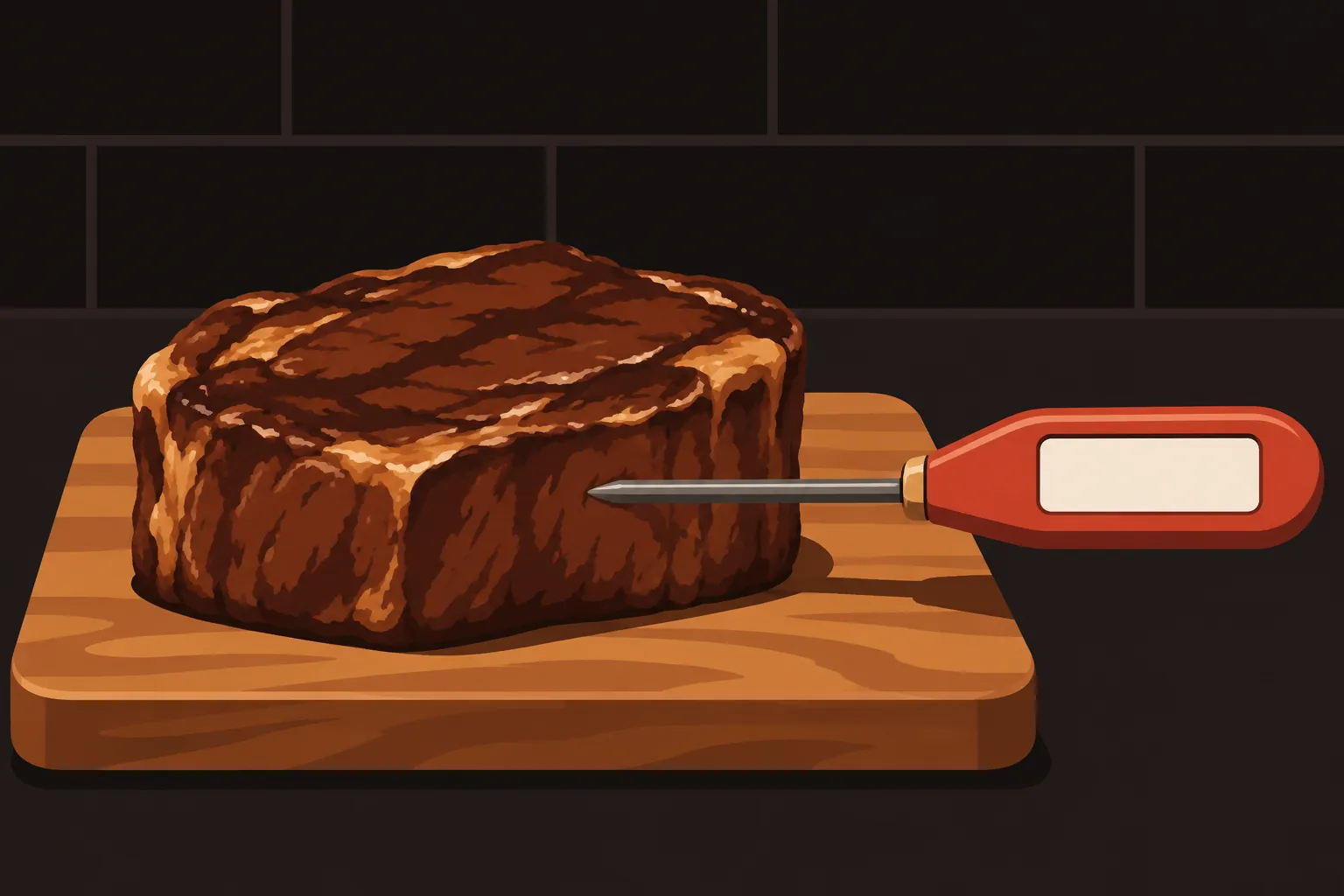
Where exactly does the probe go?
Insert it from the side into the center of the thickest part, away from bone and fat. Going in from the side puts the tip in the middle of the steak's thickness, which is hard to hit from the top of a thin steak.
How do you find the true center temperature?
Push the probe past the center, then draw it back slowly while you watch the display. The center is the last part of the steak to heat up, so the reading to trust is the lowest reading. Compare it with the pull temperatures on the doneness chart.
Which thermometer works best for steak?
The easiest fit for most steaks is a digital instant-read, pushed in from the side. Digital instant-reads sense at the tip: thermocouples read in about 2 to 5 seconds with about ¼ inch of the probe in the meat, and thermistors take about 10 seconds and need at least ½ inch. Dial thermometers sense along 2 to 2½ inches of the stem, so a dial can read a thin steak only if you push it in from the side.
For a thick steak in the oven, as in a reverse sear, a leave-in probe thermometer is designed to stay in the food while it cooks, with the probe on a cord to a base unit. An instant-read is not: take the reading, then take it out.
Does poking a steak let the juices run out?
Hardly. A probe or a fork releases almost no extra juice. In side-by-side tests, steaks turned with a fork lost the same moisture as steaks turned with tongs, and probed steaks lost no more than unprobed ones. Check as often as you need to.
How do you check that a thermometer is accurate?
Use ice water. Fill a glass with crushed ice and a little water, hold the probe at least 2 inches in for about 30 seconds, and it should read 32°F (0°C). Boiling water is a weaker check, because water boils at 212°F (100°C) only at sea level and lower at altitude.
Common questions
Does poking a steak with a thermometer let the juices out?
Barely. In side-by-side tests, probed steaks lost no more moisture than unprobed ones, and steaks turned with a fork lost the same as steaks turned with tongs.
Can I leave an instant-read thermometer in a steak while it cooks?
No. Instant-read thermometers are not made to stay in the food. For that, use a leave-in probe thermometer, which has a probe on a cord to a base unit.
How do I check that my thermometer is accurate?
Fill a glass with crushed ice and a little water, hold the probe at least 2 inches in for about 30 seconds, and check that it reads 32°F (0°C).
Sources
Every fact on this page is checked against at least two independent sources. How we check facts.
Show all 19 sources
- America's Test Kitchen, Charcoal-Grilled Strip or Rib Steaks
- America's Test Kitchen, Three Methods for Determining Doneness
- America's Test Kitchen, Does Poking Meat During Cooking Cause Moisture Loss?
- Clemson Cooperative Extension, Home & Garden Information Center, Food Thermometers: A Key to Food Safety
- LSU AgCenter (Wenqing Xu, Evelyn Watts), Food Safety and You: Choose the Thermometer That is Right For You
- N.C. Cooperative Extension, Buncombe County (Cathy Hohenstein), Choosing the Right Food Thermometer for Cooking
- Penn State Extension, Food Thermometers: Essential for Food Safety and Quality
- Serious Eats, How to Take the Temperature of Meat
- Serious Eats, How to Calibrate an Instant-Read Thermometer
- Texas A&M AgriLife Extension, Calibrating Your Food Thermometer
- ThermoWorks, Getting an Accurate Reading
- ThermoWorks, How to Temp a Steak
- ThermoWorks, Steak Temperature Guide: How to Nail Perfect Doneness Every Time
- ThermoWorks, Proper Ice Bath
- ThermoWorks blog, Temping a Steak Doesn't Make It Dry! Debunking a Kitchen Myth
- ThermoWorks blog (Kim), quoting Kenji Lopez-Alt (Serious Eats) and Meathead Goldwyn (AmazingRibs), Probe Holes Will Not Dry Out Your Steak!
- University of Georgia CAES, Calibrate food thermometer before Xmas cooking
- University of Nebraska-Lincoln Extension, Pass the Taste Test ... Use a Thermometer!
- USDA FSIS, Kitchen Thermometers (fact sheet, revised June 2011; copy hosted by Maryland Department of Health)