
Why does my steak have a grey band?
The grey band is the layer of overcooked meat between the crust and the pink center. It forms during the first hard sear, while the surface gets much hotter than the center. To shrink it, warm thick steaks gently first with a reverse sear or sous vide, or flip the steak every 30 to 60 seconds.
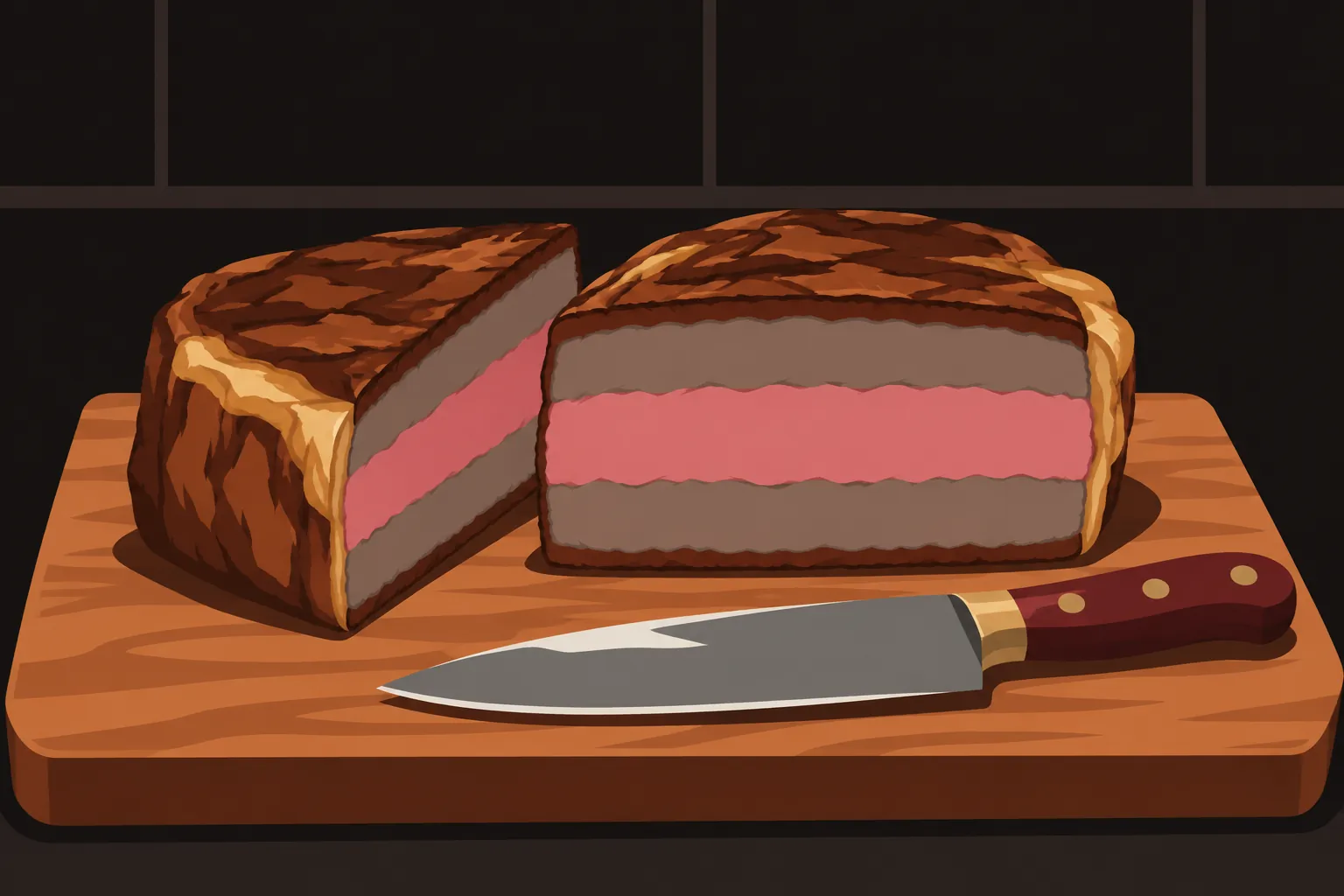
What is the grey band?
The grey band is the layer of overcooked meat between the crust and the pink center. Beef loses its red color as its myoglobin breaks down, starting between about 131 and 149°F (55 and 65°C), so any meat that gets much hotter than that turns grey-brown.
Why does a grey band form?
It forms during the first hard sear. A cold, thick steak takes minutes per side to brown, and the meat just under the crust overcooks while it does. The hotter the heat, the steeper the temperature difference between the surface and the center.
How do you avoid a grey band?
Bring the steak up gently, then sear it fast:
- Reverse sear. Gentle heat cooks a steak more evenly, with a wider window, so a reverse sear starts in a low oven and finishes with a short, hot sear.
- Two-zone grill. Cooking a thick steak over the cool side and searing it over the hot side at the end leaves a much thinner grey band.
- Sous vide. Sous vide brings the whole steak to the bath temperature, so the band comes only from the final sear.
- Flip often. Flipping every 30 to 60 seconds cooks a steak roughly a quarter to a third faster than flipping once, with a thinner grey band.
Does letting a steak come to room temperature help?
No. Leaving a steak on the counter warms the center only about 9 to 12°F in an hour, and tested side by side, tempered and fridge-cold steaks had similar grey bands.
Common questions
Does a reverse sear prevent a grey band?
It keeps it thin. The low oven brings the steak up gently and evenly, so the final sear is short and only a thin layer under the crust overcooks.
Does flipping a steak often reduce the grey band?
Yes. Flipping every 30 to 60 seconds cooks a steak more evenly than flipping once, with a thinner grey band.
Does letting a steak come to room temperature prevent a grey band?
No. An hour on the counter barely warms the center, and in side-by-side tests tempered and fridge-cold steaks had similar grey bands.
Sources
Every fact on this page is checked against at least two independent sources. How we check facts.
Show all 21 sources
- AmazingRibs.com (Meathead Goldwyn), Cooking BBQ Hot And Fast, Low And Slow, And The Reverse Sear Method
- America's Test Kitchen, The Problem with Thick-Cut Steaks
- America's Test Kitchen, Pan-Seared Thick-Cut Strip Steaks
- America's Test Kitchen, 4 Steps for Cooking the Juiciest Steak
- America's Test Kitchen, 8 Simple Tricks for Perfect Grilled Steaks
- America's Test Kitchen, The Effect of Flipping on a Crisp Burger and Steak Crust
- America's Test Kitchen, Sear Any Steak to Perfection on the Stovetop
- America's Test Kitchen, Should Steak Be Room Temperature Before Searing?
- America's Test Kitchen (Cook's Illustrated), The Easiest, Cleanest Way to Sear Steak
- America's Test Kitchen / Cook's Illustrated, Should Steak Be Room Temperature Before Searing? (Cold Sear)
- Journal of Food Science (King and Whyte, 2006), copy hosted by NZ Ministry for Primary Industries, Does It Look Cooked? A Review of Factors That Influence Cooked Meat Color
- Physics Today (American Institute of Physics), peer-reviewed magazine, The Virtual Cook: Modeling Heat Transfer in the Kitchen (McGee, McInerney, Harrus, 1999, vol. 52 no. 11)
- Serious Eats, Steak flipping cooking technique (July 15, 2026)
- Serious Eats (J. Kenji Lopez-Alt), Reverse-Seared Steak Recipe
- Serious Eats (J. Kenji Lopez-Alt), The Food Lab's Definitive Guide to Grilled Steak
- Serious Eats (J. Kenji López-Alt), The Food Lab: Flip Your Steaks (and Burgers) Multiple Times for Better Results
- Serious Eats (J. Kenji López-Alt), Pan-Seared, Butter-Basted Thick-Cut Steak
- Serious Eats (J. Kenji López-Alt), 7 Myths About Cooking Steak That Need to Go Away
- ThermoWorks, Smoked, reverse-seared ribeye steaks
- ThermoWorks, Inside Temperature Gradients: Getting to the Heart of the Thermal Center
- ThermoWorks, Carryover Cooking: the Hot Science Behind Your Food's Finish