How to reverse sear a steak
Cook the steak on a rack in a low oven at 200 to 275°F until the center is 15 to 30°F below your target, then sear it in a smoking-hot skillet to build the crust. Because the low oven leaves only a shallow temperature gradient, the steak rises much less afterward and needs little or no rest.
What do you need?
Ingredients
- 1 steak, about 1½″ thick or more
- Kosher salt
- High-smoke-point oil, such as canola or avocado
Equipment
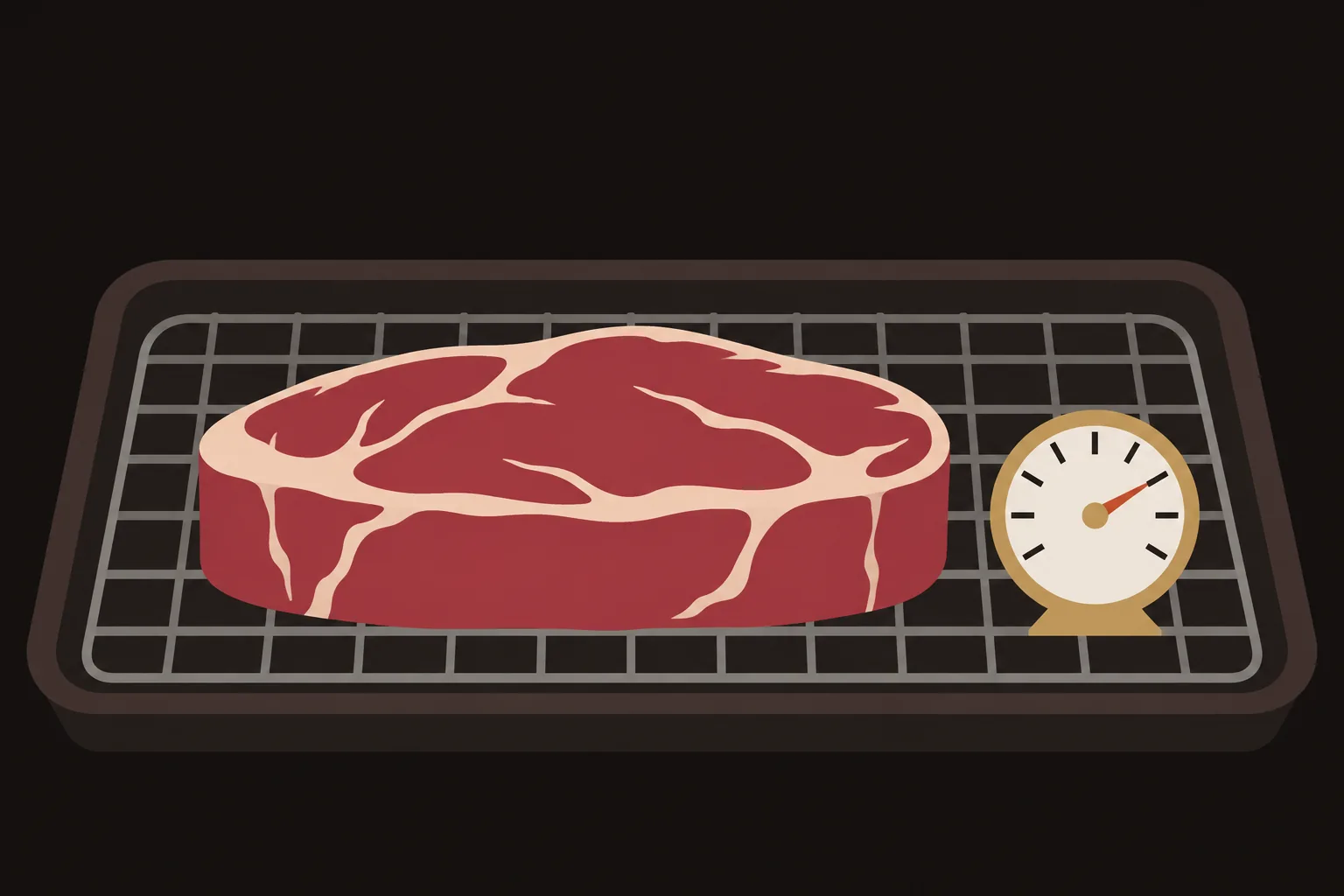
- Rimmed baking sheet with a wire rack
- Leave-in probe thermometer
- Cast iron or carbon steel skillet
- Tongs
Not sure what temperature to aim for? See the steak doneness chart and how to take a steak's temperature, or plan your exact steak below.
Step by step
- Salt ahead. Salt the steak at least 40 to 45 minutes before cooking, or up to overnight uncovered on a rack in the fridge.
- Heat the oven. Heat the oven to 200 to 275°F. Lower temperatures take longer and give you a wider window to hit your target.
- Cook low. Set the steak on a wire rack over a baking sheet, insert a probe thermometer into the center from the side, and cook until it reads 15 to 30°F below your final target.
- Heat the pan. While the steak finishes, heat a cast iron skillet with a thin film of high-smoke-point oil until it smokes.
- Sear hard and fast. Sear the steak, flipping often, just until both sides are deeply browned. Sear the edges too. The center finishes rising during the sear.
- Slice and serve. A reverse-seared steak rises much less after cooking than one seared from cold, so it needs little or no rest. Slice across the grain.
How does a reverse sear work?
A normal sear heats the outside fast while the center lags behind, which leaves the grey band of overcooked meat under the crust. A reverse sear flips the order. The low oven, at 200 to 275°F (93 to 135°C), brings the whole steak up slowly and evenly, and the short sear at the end only has to brown the surface.
How long does a reverse sear take?
A 1½-inch steak takes roughly 20 to 30 minutes in a 250 to 275°F oven to reach its pre-sear temperature for rare to medium-rare. Thicker steaks, higher targets and lower ovens all take longer. Published times for 2-inch steaks vary too much to quote, so plan extra time and let the probe thermometer decide.
When should the steak come out of the oven?
Pull it at 15 to 30°F below your target. The exact offset depends on how hot and how long you sear, so a thicker crust calls for a lower pull. A leave-in probe thermometer makes this easy, because you never have to open the oven to check.
| Doneness | Final temp | Reverse sear: out of oven |
|---|---|---|
| Rare | 125°F (52°C) | 95 to 110°F (35 to 43°C) |
| Medium-rare | 130°F (54°C) | 100 to 115°F (38 to 46°C) |
| Medium | 140°F (60°C) | 110 to 125°F (43 to 52°C) |
| Medium-well | 150°F (66°C) | 120 to 135°F (49 to 57°C) |
| Well done | 160°F (71°C) | 130 to 145°F (54 to 63°C) |
Why does a reverse-seared steak barely need to rest?
Carryover comes from heat stored in the outer layers moving inward. After a low oven the gradient is shallow, so the steak rises much less than one seared hard from cold. Serve it as soon as the sear is done.
Why salt the steak ahead of time?
Salting at least 40 to 45 minutes ahead, or up to overnight gives the salt time to dissolve and be reabsorbed. The low oven also dries the surface, which helps the sear brown fast, since a wet surface cannot get hotter than 212°F (100°C).
When is a reverse sear the wrong choice?
For thin steaks, under about an inch, the oven step adds time without much benefit and the sear can overshoot the center. Pan-sear them instead.
Plan your steak
Preset to reverse sear. Pick your cut, thickness and doneness to see the pull temperature and every step.
- Out of oven
- 100 to 115°F
- Final center
- 130°F
- Rest
- Little or none
Watch it cook
Roughly 20 to 30 minutes in a 250 to 275°F oven for a 1½″ steak, before the sear (America's Test Kitchen, Serious Eats).
The animation is a heat-transfer simulation of the inside of the steak, not a timer. Stoves and grills vary, so cook to temperature: check the center with an instant-read thermometer.
Common questions
What oven temperature is best for a reverse sear?
Use a low oven, about 200 to 275°F (93 to 135°C). The lower end cooks more evenly but takes longer. Always cook to the steak's internal temperature, not to a set time.
How long does a reverse sear take in the oven?
A 1½-inch steak takes roughly 20 to 30 minutes in a 250 to 275°F oven to reach its pre-sear temperature for rare to medium-rare. Thicker steaks, higher targets and lower ovens take longer, so go by a probe thermometer.
When do you take a reverse-seared steak out of the oven?
Take it out about 15 to 30°F below the final temperature you want. The sear supplies the rest of the rise.
Do you need to rest a reverse-seared steak?
Not much. The low oven leaves only a shallow temperature gradient, so the center rises much less after searing than a steak seared hard from cold. You can slice it almost right away.
Sources
Every fact on this page is checked against at least two independent sources. How we check facts.
Show all 26 sources
- America's Test Kitchen, The Problem with Thick-Cut Steaks
- America's Test Kitchen, Pan-Seared Thick-Cut Strip Steaks
- America's Test Kitchen, The Effect of Flipping on a Crisp Burger and Steak Crust
- America's Test Kitchen, Roasted Thick-Cut Rib-Eye Steaks
- America's Test Kitchen, Thick-Cut Porterhouse Steaks
- America's Test Kitchen, Reverse-Seared Strip Steaks with Cowboy Butter
- America's Test Kitchen, How to Cook a Juicy Steak - Bake + Sear
- America's Test Kitchen, How to Grill Steak Without a Recipe
- America's Test Kitchen, How to Season Steak for the Best Flavor
- America's Test Kitchen, The Easiest Way to Make Steak Taste Even Better: Salt Twice
- America's Test Kitchen, Doneness Temperatures for Beef and Lamb
- America's Test Kitchen / Cook's Illustrated, Should Steak Be Room Temperature Before Searing?
- America's Test Kitchen / Cook's Illustrated, Butter-Basted Rib-Eye Steak
- Douglas Baldwin, A Practical Guide to Sous Vide Cooking
- Physics Today (American Institute of Physics), The Virtual Cook: Modeling Heat Transfer in the Kitchen (McGee et al., 1999)
- Serious Eats, What Is the Maillard Reaction?
- Serious Eats (J. Kenji Lopez-Alt, The Food Lab), via secondary report, The Food Lab: salting steak (2011)
- Serious Eats (J. Kenji López-Alt), Reverse-Seared Steak
- Serious Eats (J. Kenji López-Alt), The Food Lab: Flip Your Steaks (and Burgers) Multiple Times
- Serious Eats (J. Kenji López-Alt), Perfect Pan-Seared Steaks (The Food Lab: More Tips for Perfect Steaks)
- Serious Eats (J. Kenji López-Alt), The Food Lab's Complete Guide to Sous Vide Steak
- ThermoWorks, Carryover Cooking: the Hot Science Behind Your Food's Finish
- ThermoWorks, Grilled Rib Eye Steak: Reverse Sear and Thermal Principles
- ThermoWorks, Steak Temperature Guide (reverse sear steps)
- ThermoWorks, Steak Temperature: Getting It Right
- ThermoWorks, Thermal Tips: Searing Meat