How can you tell if steak is done without a thermometer?
You can estimate it from color and feel: the center goes from soft and red at rare, to pink throughout at medium, to little or no pink at well done, firming up as it cooks. But neither is reliable. Home cooks using the finger test scored low in a peer-reviewed test, so a thermometer is the only sure check.
What does each doneness look like inside?
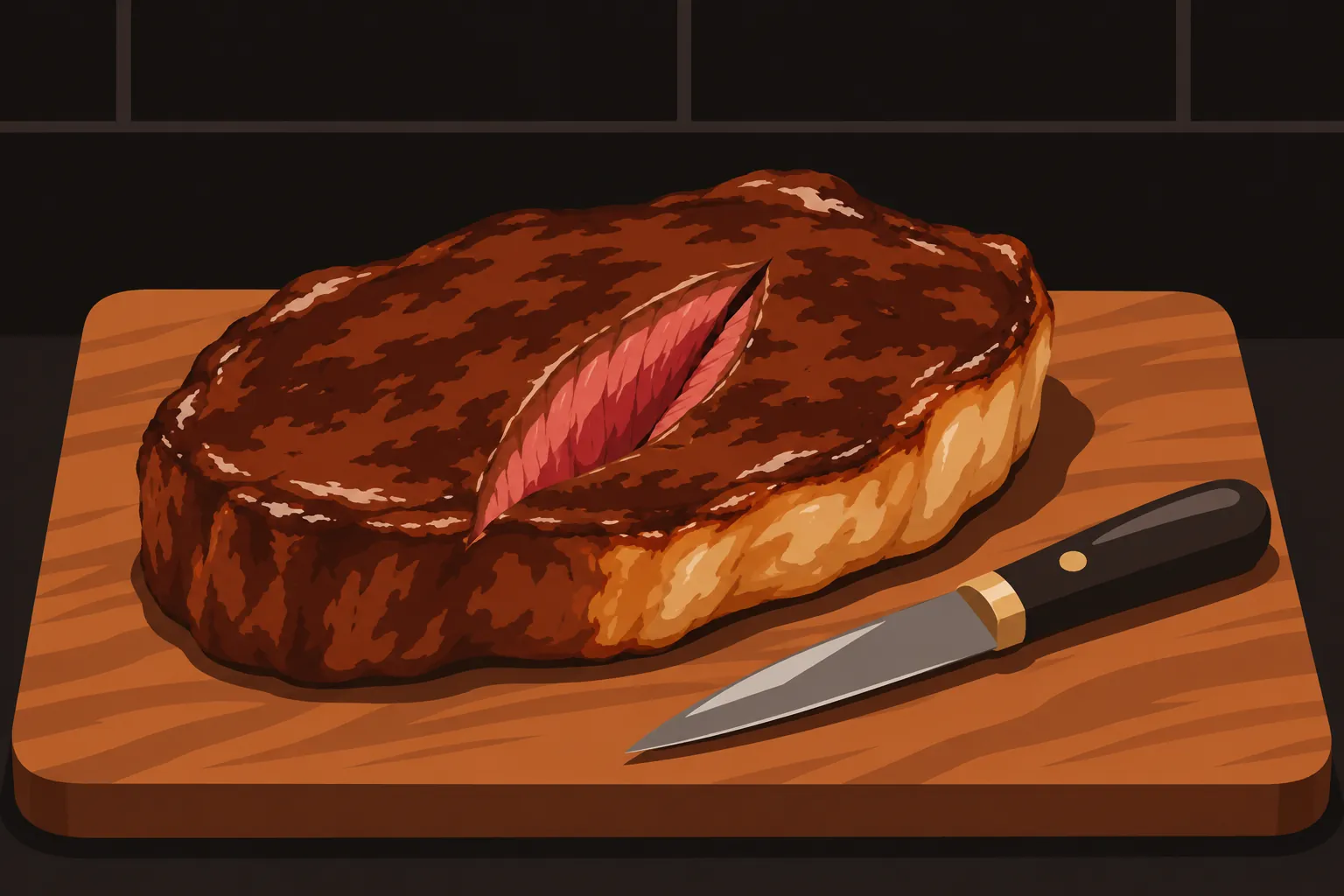
As a steak cooks, the center goes red, then pink, then little or no pink. At rare it is soft, slick and red. At medium-rare it is an opaque red that has started to firm. At medium it is pink throughout, and at medium-well and well done there is little or no pink, with firmer, drier meat. The doneness chart shows each stage with its temperature.
Is the finger test accurate?
No. Judging doneness by feel is unreliable. In a peer-reviewed study, home cooks using the finger test did better than chance, but their overall accuracy was low, and the authors recommend a more reliable test. Hands differ from person to person and cuts differ in firmness, so the same press can mean different things.
Can you cut into a steak to check it?
You can look, but the color inside a steak is not a reliable sign of doneness. Packaging, pH, fat content and other factors can make beef brown before it is done or stay pink after. A thermometer probe, by contrast, releases almost no extra juice.
Can you go by cooking time instead?
Only roughly. Cooking time grows much faster than thickness: a steak twice as thick takes about four times as long to heat through to the center. A time that works for one steak can miss badly on a thicker or thinner one. The cook planner gives times by thickness, but check the center before you pull it.
What is the most reliable way to check doneness?
An instant-read thermometer pushed in from the side to the center of the steak. See where to put a thermometer in a steak for placement, the right type and a quick accuracy check.
Common questions
Does the finger test work for steak?
Not well. In a peer-reviewed test, home cooks using it did better than chance but had low overall accuracy. Hands and cuts differ in firmness, so a thermometer is the reliable check.
Can a steak look done before it is, or look underdone after it is cooked?
Yes, both. Packaging, pH, fat content and other factors can make beef brown before it is done or stay pink after, so color alone does not tell you the temperature.
Does a thermometer let the juices out?
Almost none. In side-by-side tests, probed steaks lost no more moisture than unprobed ones.
Sources
Every fact on this page is checked against at least two independent sources. How we check facts.
Show all 21 sources
- America's Test Kitchen, Well-Done Meat
- America's Test Kitchen, Three Methods for Determining Doneness
- America's Test Kitchen, Does Poking Meat During Cooking Cause Moisture Loss?
- America's Test Kitchen / Cook's Illustrated, Pan-Seared Filet Mignon
- Beef Checkoff, beefresearch.org (PI Jeff Savell, Texas A&M, 2003), Biochemical, Raw and Cooked Color Characteristics (project summary)
- Cook's Illustrated / America's Test Kitchen (June 25, 2018), Why Are Sous Vide Cooking Times So Long?
- Douglas Baldwin, A Practical Guide to Sous Vide Cooking
- HarvardX (Harvard University), SPU 27 Science and Cooking, Week 6 Science Review Handout: Heat Transfer
- Journal of Food Science (King and Whyte, 2006, 71(4); PDF hosted by NZ Ministry for Primary Industries), Does It Look Cooked? A Review of Factors That Influence Cooked Meat Color
- Medical Journal of Australia (Vinycomb et al., 2015, 203(11):467-469), Studying the Thenar Eminence of Amateur cooKs (STEAK) study: a double-blinded, cross-sectional study
- Penn State Extension, Food Thermometers: Essential for Food Safety and Quality
- Physics Education (IOP), peer-reviewed; Rowat, Sinha, Sorensen et al. 2014, The kitchen as a physics classroom (Phys. Educ. 49(5) 512, doi:10.1088/0031-9120/49/5/512)
- Serious Eats (J. Kenji Lopez-Alt), Sous Vide Steak Guide | The Food Lab
- South Dakota State University Extension (Amanda Blair), Is it Done Yet? How to Determine Meat is Cooked Properly
- Texas Tech University Meat Science, Slice Shear Force/Cooked Color/Warner-Bratzler Shear Force protocol
- ThermoWorks, Steak Temperature Guide: Perfect Doneness
- ThermoWorks, Steak Temperature Guide: How to Nail Perfect Doneness Every Time
- ThermoWorks blog, Poking meat with a thermometer: will all the juices drain?
- ThermoWorks blog, Temping a Steak Doesn't Make It Dry! Debunking a Kitchen Myth
- ThermoWorks blog (Meathead Goldwyn, AmazingRibs.com, reproduced), Meathead's Myth #3: Thermometers are for sissies
- USDA FSIS (fact sheet PDF, revised June 2011, copy hosted by Maryland Department of Health), Kitchen Thermometers