
What is the difference between Prime, Choice and Select beef?
Prime, Choice and Select are USDA quality grades set mainly by marbling. Prime has the most, Choice less and Select the least. On average more marbling makes a steak juicier, more flavorful and more tender, but grade is not a guarantee. Choice is the most common grade; Prime is a small share of graded beef.
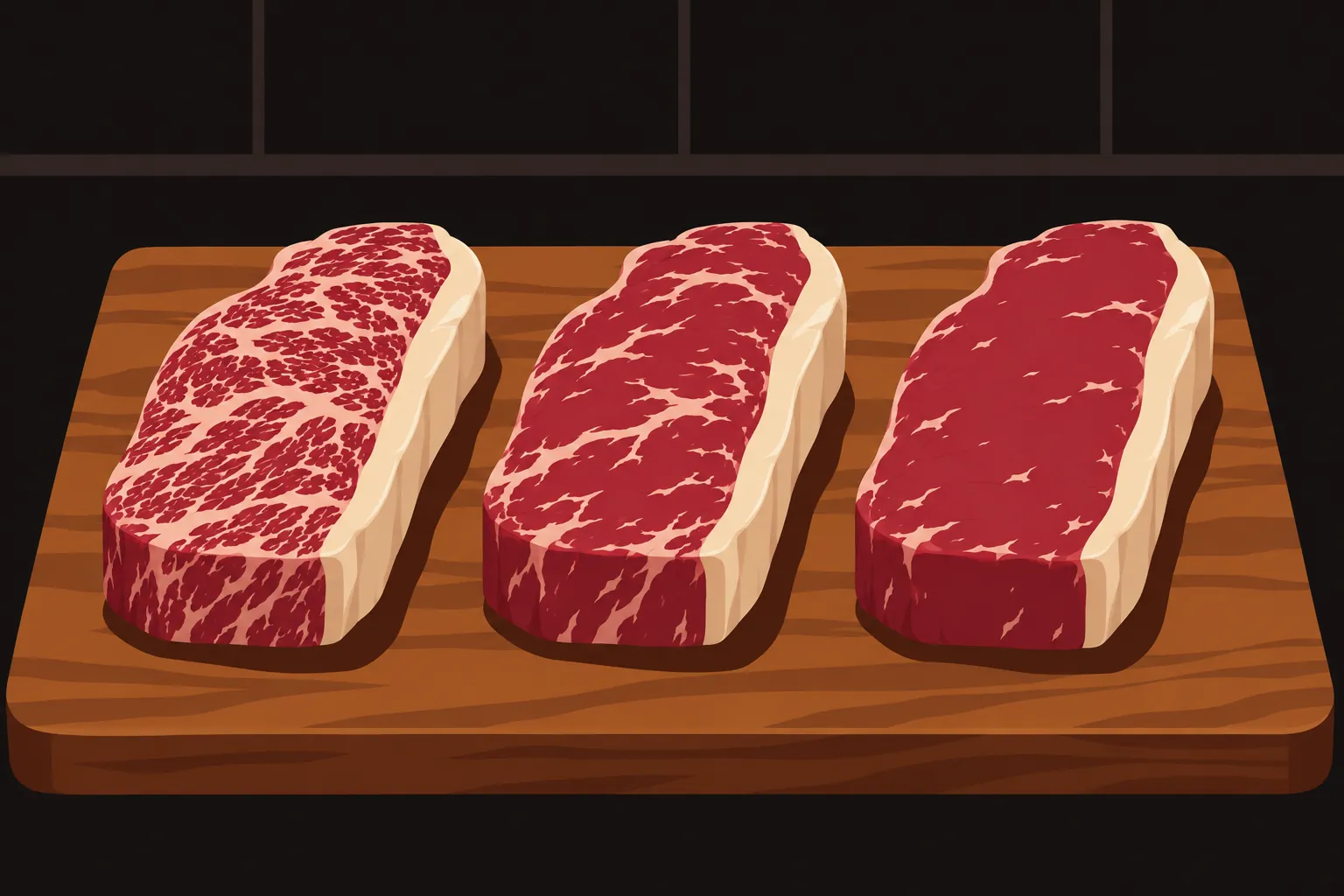
What do Prime, Choice and Select mean?
They are USDA quality grades. The grade is set mainly by the marbling in the ribeye, judged together with the animal's maturity: Prime the most marbling, then Choice, then Select. For young cattle, Prime needs at least a slightly abundant amount of marbling, Choice at least a small amount and Select at least a slight amount. These grades are restricted to beef from young cattle, and beef from cows cannot grade Prime.
Is all beef graded?
No. USDA grading is voluntary, and paid for by the packer, so some beef is sold with no grade at all.
Which grade is most common?
Choice. In recent years, graded fed cattle have been about three-quarters Choice, with roughly 8 to 12% Prime and about 13 to 16% Select.
Does a higher grade taste better?
Usually, yes. In consumer and trained taste panels, more marbled steaks rate juicier, more flavorful and usually more tender, on average. Grade is not a guarantee, though: tenderness overlaps a lot between grades, and many Choice steaks are tougher than many Select steaks.
Is Select beef worth buying?
It can be. Beef that grades at least Select is acceptable to most consumers, though higher grades are rated acceptable more often. The cut matters too; see the steak cuts for how each one eats.
Common questions
What is the difference between Prime and Choice?
Marbling. For young cattle, Prime needs at least a slightly abundant amount of marbling and Choice at least a small amount, so Prime steaks are more marbled. On average that makes them juicier and more flavorful.
Is Choice beef good for steak?
Yes. Choice is the most common grade, about three-quarters of graded fed cattle in recent years. Higher grades rate better on average, but grade is not a guarantee: many Choice steaks are tougher than many Select steaks.
Is USDA beef grading required?
No. Grading is voluntary, and the packer pays USDA a fee for it.
Sources
Every fact on this page is checked against at least two independent sources. How we check facts.
Show all 15 sources
- Beef Checkoff (beefresearch.org), Daryl Tatum, Colorado State University, Beef Grading (fact sheet)
- Beef Checkoff (NCBA) / Colorado State University, Daryl Tatum, Beef Grading fact sheet
- Journal of Agricultural and Applied Economics (Riley, Schroeder, Wheeler, Shackelford, Koohmaraie; hosted by USDA ARS), Valuing Fed Cattle Using Objective Tenderness Measures (2009)
- Journal of Animal Science (Emerson, Woerner, Belk, Tatum, Colorado State University, 2013), Effectiveness of USDA instrument-based marbling measurements for categorizing beef carcasses according to differences in longissimus muscle sensory attributes
- Journal of Animal Science (Killinger et al., University of Nebraska-Lincoln, 2004), Consumer Sensory Acceptance and Value for Beef Steaks Differing in Marbling Level
- Meat Science (Corbin et al., Texas Tech University, 2015), Sensory evaluation of tender beef strip loin steaks of varying marbling levels and quality treatments
- Montana State University Extension, How to Choose Beef: Consumer Choices and Meat Grading (2024)
- South Dakota State University Extension, USDA Remote Grading Pilot Program Increasing Marketing Options for Small Plants
- Southern Ag Today, hosted by Texas A&M Agricultural and Food Policy Center (Josh Maples), Cattle Prices Hit New Highs and Carcass Grading Trends Over Time (May 6, 2025)
- Texas A&M AgriLife Today, Beef grades 101: Select, Choice or Prime? (June 25, 2024)
- Translational Animal Science (Mayer et al., Savell corresponding; funded in part by the Beef Checkoff), National Beef Quality Audit - 2022: Instrument grading assessments of carcass characteristics of fed steers and heifers (2025)
- Translational Animal Science (O'Quinn, Legako, Brooks, Miller; Texas Tech / Kansas State), Evaluation of the contribution of tenderness, juiciness, and flavor to the overall consumer beef eating experience (2018)
- USDA Agricultural Marketing Service, United States Standards for Grades of Carcass Beef (effective December 18, 2017)
- USDA Agricultural Marketing Service, Carcass Beef Grades and Standards
- USDA Agricultural Research Service, Agricultural Research magazine, Beef (March 1995)