
What is the difference between dry-aged and wet-aged steak?
Wet-aged beef ages in a vacuum bag in the fridge, and it is how most beef is aged. Dry-aged beef ages unpackaged for several weeks in a cold room with controlled humidity and airflow. Dry aging gives a more concentrated, beefy flavor but loses more weight, and in most studies it is no more tender.
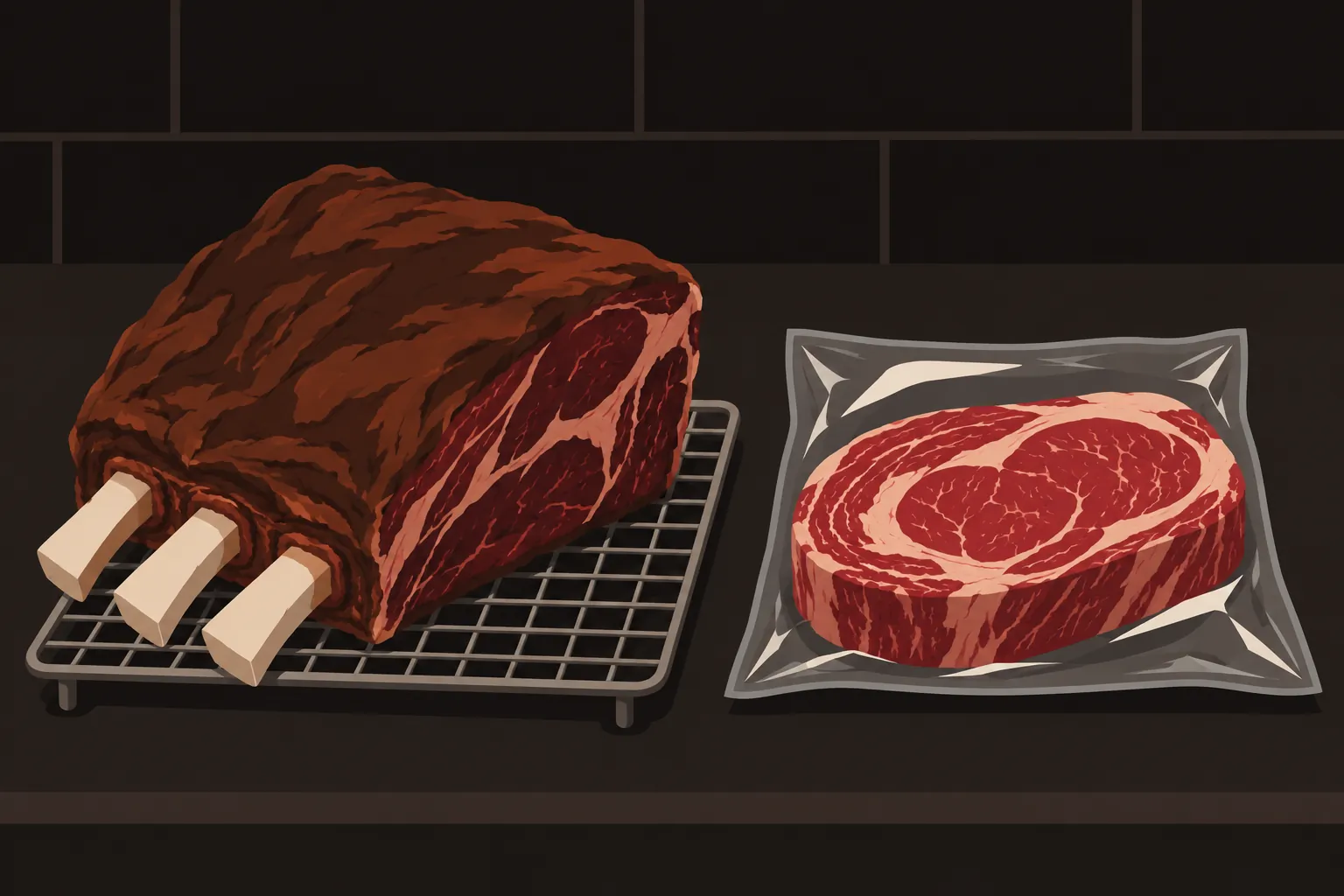
How are dry-aged and wet-aged beef made?
Beef is aged cold, one of two ways: in a vacuum bag, or unpackaged in a controlled cold room. Wet aging, in the bag, is the main way beef is aged today. Dry aging holds whole carcasses or large cuts in rooms kept near freezing, commonly about 32 to 39°F (0 to 4°C), with controlled humidity and moving air.
How long is beef dry-aged?
Commercial dry aging lasts several weeks. Sources differ on the range: one to five weeks, 21 to 42 days, or 28 to 55 days.
Does dry-aged steak taste different?
It develops a more concentrated, beefy flavor. Dry aging raises free amino acids, sugars and short peptides in the meat, and tasters describe it as beefy, nutty, earthy or roasted. In blind tests, though, results are mixed: Texas A&M consumers could not tell dry-aged from wet-aged steaks, while a Purdue study of lean grass-fed beef found dry-aged steaks preferred for flavor.
Is dry-aged steak more tender?
Usually not. Dry-aged steak is no more tender than wet-aged steak, in most studies. In one Texas A&M test, wet-aged ribeyes even rated more tender, while one Purdue study of lean grass-fed beef found dry-aged steaks preferred for tenderness.
Does dry aging lose meat?
Yes. Dry-aged beef loses more weight to shrink and trim than wet-aged beef, so it yields less meat to sell.
Can you dry-age steak at home?
Whether you can dry-age single steaks at home is disputed. America's Test Kitchen ages steaks for 3 to 4 days on a rack in the coldest part of a home fridge, wrapped in cheesecloth, and found the short aging mostly improves the sear. ThermoWorks and AmazingRibs say a single steak cannot be properly dry aged.
For real dry aging at home, those two age a whole loin or rib roast, for about four weeks or more, in a clean fridge used only for that and kept around 30 to 39°F. Both say the flavor change becomes clear at about 28 days.
Dry-aging bags, which let moisture escape, gave about the same eating quality, with less loss than traditional dry aging in several studies. Those studies aged loin sections in controlled coolers, though, not in home fridges.
Common questions
Is dry-aged steak worth it?
It depends on whether you like the flavor. Dry aging gives a more concentrated, beefy flavor, but in most studies it is no more tender than wet-aged steak, and consumer taste tests are mixed.
How is most beef aged?
Wet aged, in vacuum packaging under refrigeration. It is the main way beef is aged today.
How long is dry-aged beef aged?
Several weeks. Sources give one to five weeks, 21 to 42 days, or 28 to 55 days.
Sources
Every fact on this page is checked against at least two independent sources. How we check facts.
Show all 20 sources
- AmazingRibs.com (Meathead Goldwyn), How to Dry Age Steak At Home
- America's Test Kitchen, Technique #81: Dry-Age in the Refrigerator for the Ultimate Beef
- America's Test Kitchen, Dry-Aging Steak at Home
- America's Test Kitchen, You Can Dry-Age Steaks in Your Fridge
- Beef Checkoff (NCBA), Postmortem Aging fact sheet
- Beef Checkoff project summary (Savell et al., Texas A&M, 2007), Tenderness, flavor and yield assessments of dry and wet aged beef
- Journal of Animal Science and Technology (Dashdorj et al., 2016), Dry aging of beef; Review
- Journal of Animal Science and Technology (Dashdorj, Tripathi, Cho, Kim, Hwang), Dry aging of beef; Review (2016)
- Kansas State University (Meat Science, via Europe PMC), Effects of dry aging of bone-in and boneless strip loins using two aging processes for two aging times (DeGeer et al. 2009)
- Meat Science (Berger, Kim, Legako, et al.; Purdue University, 2018), Dry-aging improves meat quality attributes of grass-fed beef loins
- Meat Science (Smith, Nicholson, Nicholson, Harris, Miller, Griffin, Savell; Texas A&M, 2008), Dry versus wet aging of beef: Retail cutting yields and consumer palatability evaluations of steaks from US Choice and US Select short loins
- Metabolites (Setyabrata et al.; Purdue University, 2022), Characterizing the Flavor Precursors and Liberation Mechanisms of Various Dry-Aging Methods in Cull Beef Loins Using Metabolomics and Microbiome Approaches
- Swedish University of Agricultural Sciences (Li, Babol, Wallby, Lundström), Meat Science, Meat quality, microbiological status and consumer preference of beef gluteus medius aged in a dry ageing bag or vacuum (2013, abstract via Europe PMC)
- Swedish University of Agricultural Sciences (Meat Science, via Europe PMC), A comparative study of beef quality after ageing longissimus muscle using a dry ageing bag, traditional dry ageing or vacuum package ageing (Li et al. 2014)
- Swedish University of Agricultural Sciences and Kansas State University (Meat Science, via Europe PMC), Dry aging of beef in a bag highly permeable to water vapour (Ahnström et al. 2006)
- Texas A&M University, Dept. of Animal Science (Jeff W. Savell; prepared for NCBA checkoff), Dry-Aging of Beef: Executive Summary
- ThermoWorks, Dry Aging Beef at Home: A Thermal How-To
- ThermoWorks, Dry Aging Beef at Home: A Thermal How-To
- University of Missouri Extension (Hedrick, Stringer, Clarke; G2209, 1993, reviewed 2017), Recommendations for Aging Beef
- University of Nevada, Reno Extension (A.S. de Mello), Effects of wet and dry aging on yields, tenderness and microbial loads of beef loins (FS 19-01, 2019)